What Professional Commercial Grass Mowing Actually Involves
Commercial grass mowing is the regular cutting, trimming, and maintenance of turf on business properties — and doing it right takes more than just running a mower over the lawn.
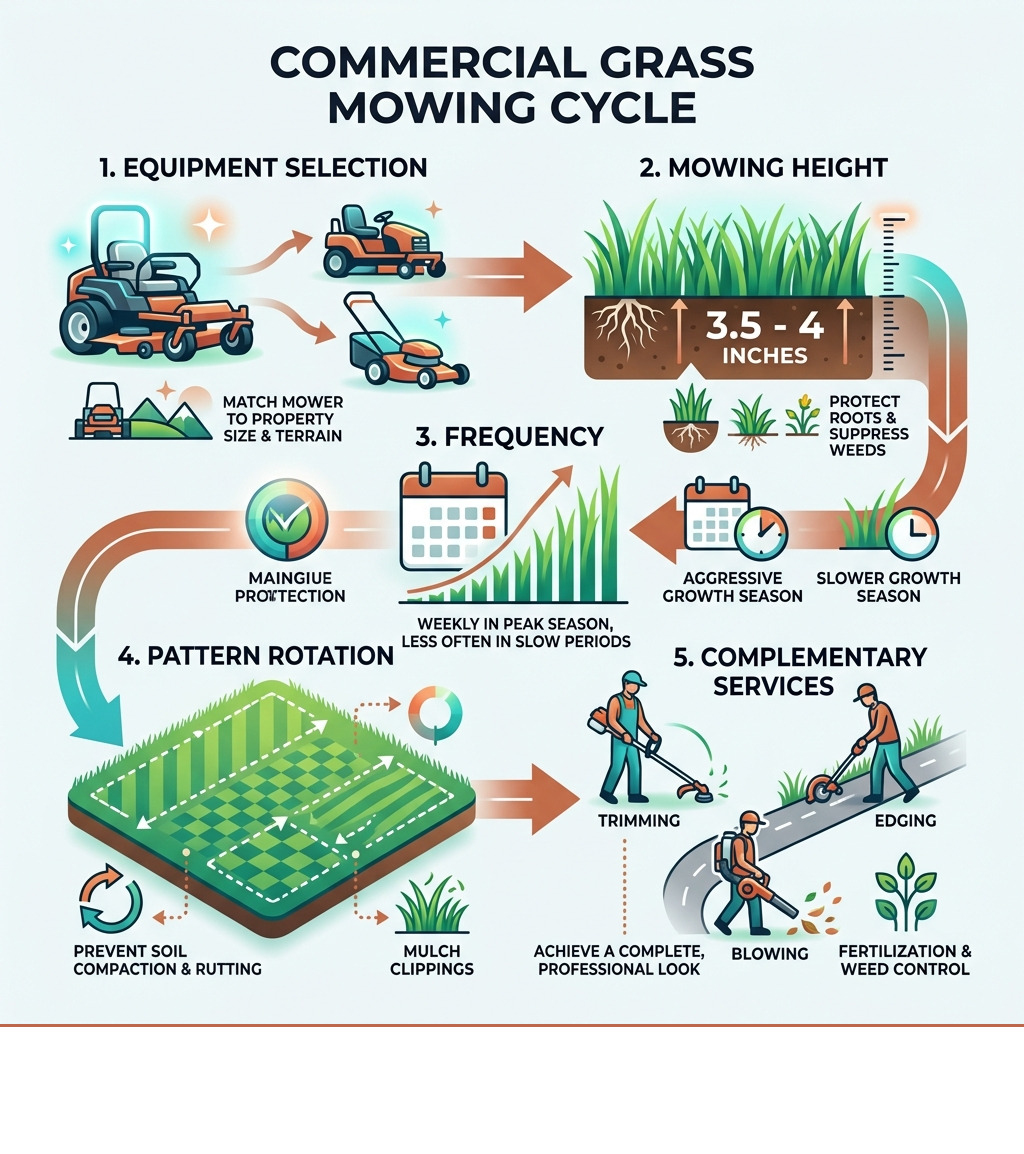
Here’s a quick look at what professional commercial mowing covers:
- Equipment: Zero-turn, stand-on, and walk-behind mowers matched to property size and terrain
- Mowing height: Typically 3.5 to 4 inches to protect roots and suppress weeds
- Frequency: Weekly during peak growth seasons, less often when grass slows down
- Techniques: Rotating mowing patterns, dry-grass-only mowing, and mulching clippings
- Complementary services: Edging, trimming, blowing, fertilization, and weed control
These aren’t just nice-to-haves. Each one directly affects how healthy, safe, and professional your property looks.
A well-maintained commercial lawn does more than look good. It signals attention to detail to every client, employee, and visitor who pulls into your parking lot. When grass is overgrown, patchy, or poorly cut, it creates a first impression that’s hard to shake.
The difference between basic mowing and professional commercial mowing comes down to technique, equipment, and consistency. That’s what this guide covers.
I’m Tyler Wilson, owner of Copperhead Lawn Care, and since 2020 I’ve worked with commercial clients throughout the Tampa Bay area delivering reliable commercial grass mowing and property maintenance. I’ll walk you through exactly how the pros do it.
Selecting the Right Equipment for Commercial Grass Mowing
In professional landscaping, the “one-size-fits-all” approach to machinery is a recipe for inefficiency. When we tackle Commercial Maintenance in areas like Lutz or Wesley Chapel, we select equipment based on the specific “physics” of the property.
Zero-Turn Mowers: The Production Powerhouses
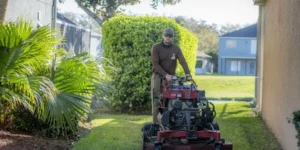
Zero-turn mowers are the backbone of commercial fleets. Their ability to turn 360 degrees on a dime allows us to navigate around obstacles like signposts and light poles without stopping. For large, open commercial parks, these machines are unmatched.
We typically utilize deck sizes ranging from 48 inches to 96 inches. For massive industrial sites, some specialized wide-area mowers can even feature reconfigurable cutting widths up to 100 or 144 inches, allowing us to clear acres of grass in a fraction of the time.
Stand-On Mowers: The Versatile Middle Ground
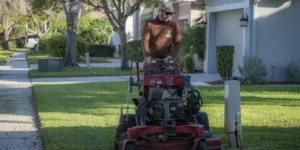
Stand-on mowers have become a “game-changer” for modern crews. They offer a smaller footprint than a seated zero-turn, making them easier to transport and maneuver in tighter commercial spaces. They are excellent for mixed terrain and properties with frequent hills or tight turns. Deck sizes for these usually range from 32 to 72 inches. One unique advantage is their visibility; because the operator is standing, they have a better view of potential debris or hazards in the grass.
Walk-Behind Mowers: Precision and Safety
For sloped areas, narrow gated entryways, or delicate pond banks, the commercial walk-behind is essential. These aren’t your standard residential push mowers. Commercial-grade walk-behinds feature heavy-duty 13-gauge steel decks and larger fuel tanks for continuous operation. We use these for “detail work” where larger machines might cause turf damage or present a safety risk on steep inclines.
| Mower Type | Ideal Property Size | Best Terrain | Key Benefit |
|---|---|---|---|
| Zero-Turn | 1+ Acre | Flat, open spaces | Maximum speed and production |
| Stand-On | 0.5 – 2 Acres | Mixed terrain, tight turns | High visibility and agility |
| Walk-Behind | Small – Medium | Slopes, narrow paths | Precision and safety on inclines |
Professional Techniques for a Pristine Finish
Achieving a professional look isn’t just about cutting the grass; it’s about managing the health of the ecosystem. In Florida, where we deal with heat and specific grass types like St. Augustine or Bahia, height is everything.
The Golden Rule of Mowing Height
One of the biggest mistakes property managers make is asking for the grass to be “cut short” to save on mowing frequency. This actually harms the lawn. We generally aim for a mowing height between 3.5 and 4 inches.
Why so high? Taller grass blades provide shade to the soil. This shading blocks sunlight from reaching weed seeds, significantly helping in The Role of Lawn Mowing in Preventing Weeds and Pests in Florida Yards. Furthermore, taller grass promotes deeper root growth. When the top of the plant is healthy, the roots dive deeper into the soil, making the turf more resilient during our hot Florida dry spells and improving moisture retention.
Best Practices for Commercial Grass Mowing Patterns
If you always mow a lawn in the same direction, you’ll eventually notice “ruts” or permanent tracks in the soil. This is caused by soil compaction. To prevent this, our crews rotate the mowing direction every single visit.
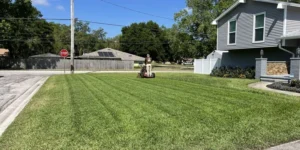
Changing patterns (from north-south to east-west or diagonal) ensures the grass blades don’t lean in one direction and prevents the heavy weight of commercial machinery from packing down the dirt in the same spots. It also creates that high-end “checkerboard” or “striped” aesthetic that makes a business look truly prestigious. You can see examples of these patterns in Our Work.
Managing Clippings During Commercial Grass Mowing
There is a common myth that grass clippings cause thatch buildup. In reality, clippings are mostly water and nutrients. We prefer to use mulching mowers that finely chop the grass and return it to the soil.
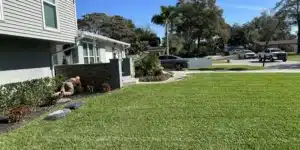
This “nutrient recycling” acts as a natural fertilizer, returning nitrogen to the lawn and reducing the need for chemical inputs. It also keeps waste out of local landfills. However, we are always careful to clear clippings from sidewalks, parking lots, and entryways using high-powered blowers to maintain a tidy appearance. We take pride in leaving every site cleaner than we found it, as seen in our Recent Projects.
Scheduling and Seasonal Adjustments
In April 2026, we are moving into the peak growing season here in Florida. Commercial grass doesn’t grow at a constant rate, so a “rigid” schedule can sometimes be counterproductive.
Optimizing Frequency in Commercial Grass Mowing
During the spring and summer, a typical office building or retail center requires weekly commercial grass mowing. The combination of rain and heat can make grass grow so fast you can almost see it happening. If we wait too long, we end up cutting more than one-third of the grass blade at once, which stresses the plant and turns it yellow.
However, as we move into the cooler months or during periods of extreme drought, we may reduce frequency to bi-weekly or even three times a month. When the temperature stays consistently high (above 90 degrees) without rain, some grasses go into a semi-dormant state to protect themselves. Mowing too often during this time can actually “scorch” the lawn.
The Importance of Dry Mowing
We always monitor the weather closely across our Service Areas. Mowing on wet grass is a major “no-no” for professionals. Wet clippings clump together, creating “clods” that can smother the grass underneath. More importantly, heavy commercial mowers can easily create deep ruts in soft, saturated soil. We wait for the grass to dry to ensure a clean, even cut that doesn’t damage the property’s foundation.
While we specialize in large-scale properties, the same principles of timing and weather apply to Residential Mowing to keep neighborhood lawns looking their best.
Essential Maintenance and Complementary Services
The quality of the cut is only as good as the blade doing the work. A dull blade doesn’t “cut” grass; it tears it. Tattered grass ends turn brown and become entry points for disease and pests. To avoid this, we sharpen our mower blades frequently—often twice a week during peak season—and wash our mower decks daily to prevent the spread of weed seeds or fungi between properties.
Beyond the actual mowing, a true commercial service includes several essential “finishing touches”:
- String Trimming: Getting into the spots the mower can’t reach, like around fence lines, trees, and flower beds.
- Steel-Blade Edging: Using a vertical blade to create a sharp, clean “groove” between the grass and hard surfaces like sidewalks and curbs.
- Blower Service: Ensuring all hardscapes are free of debris, leaves, and clippings.
- Fertilization and Weed Control: Coordinating mowing with nutrient applications to ensure the grass has the fuel it needs to recover and stay green.
Frequently Asked Questions about Commercial Mowing
Should grass clippings be left on a commercial lawn?
Yes, in most cases. When using professional mulching equipment, clippings break down quickly and return vital nutrients like nitrogen to the soil. This improves soil health and reduces the need for supplemental fertilizers. We only bag or remove clippings if the grass has become excessively overgrown or if the client has a specific event where a “golf-course” finish is required.
Why is it important to avoid mowing wet grass?
Mowing wet grass leads to uneven cuts because the blades of grass are weighed down by water. It also causes the mower to “clump” clippings, which can block the mower deck and leave messy piles on the lawn. Most importantly, operating heavy machinery on wet, soft turf can cause soil compaction and permanent rutting.
How does mowing height influence weed growth?
Mowing height is your first line of defense against weeds. By keeping the grass at 3.5 to 4 inches, the thick canopy shades the soil surface. Most weed seeds need direct sunlight to germinate; without it, they stay dormant. Taller grass also allows for deeper roots, which helps the “good” grass out-compete weeds for water and nutrients.
Conclusion
At Copperhead Property Maintenance, we believe that commercial grass mowing is an art form that requires the right tools, the right timing, and a deep understanding of local Florida conditions. Serving Lutz, Land o’ Lakes, Wesley Chapel, and the surrounding areas, we bring professional attention to detail to every property we touch.
Whether you manage a sprawling office park in Odessa or a retail center in South Tampa, our reliable maintenance schedules are designed to enhance your curb appeal and keep your turf healthy year-round.
Contact our experts for professional commercial maintenance today and let us help your business make the best possible first impression.