Sod vs Seed: Which Lawn Method Is Right for You?
Sod vs seed are the two main ways to establish a new lawn — and each comes with real trade-offs worth understanding before you commit.
Here’s a quick side-by-side to help you decide fast:
| Factor | Sod | Seed |
|---|---|---|
| Time to usable lawn | 2-4 weeks | 2-4 months |
| Upfront effort | High (installation) | Moderate (ongoing care) |
| Grass variety options | Limited | Wide selection |
| Erosion control | Immediate | Slow to establish |
| Weed resistance | Strong from day one | Vulnerable early on |
| Best for | New builds, slopes, quick results | Repairs, large areas, specific grass needs |
| DIY difficulty | Moderate to hard | Easier for most homeowners |
Neither method is universally better. The right choice depends on your yard conditions, timeline, and goals.
I’m Tyler Wilson, owner of Copperhead Lawn Care in Lutz, Florida, and I’ve worked through the sod vs seed decision with countless Tampa Bay homeowners across a wide range of yard conditions. In this guide, I’ll walk you through everything you need to make a confident choice for your property.
Understanding the Basics: What is Sod vs Seed?
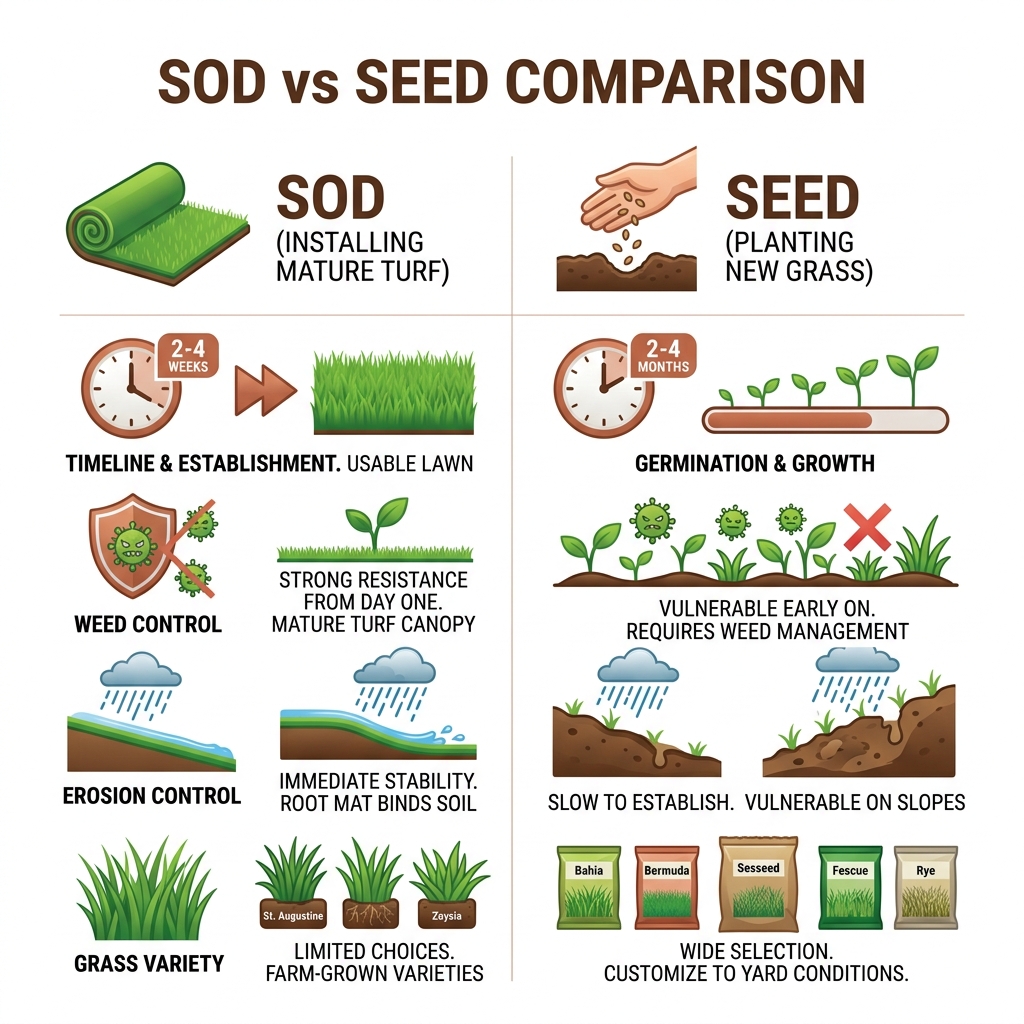
When we talk about the sod vs seed debate, we are looking at two very different starting lines for your lawn. Sod is essentially a “living carpet.” It consists of mature turfgrass that has been professionally grown on a farm for 18 to 24 months. When it’s harvested, a thin layer of soil and the root system are cut along with the blades, allowing us to roll it out over your prepared soil for an “instant” transformation.
On the other hand, seeding is the process of planting individual grass seeds directly into your soil. This is the traditional method of growing a lawn from scratch. It requires a germination period where the seeds sprout, followed by a long establishment phase where the young shoots must survive the elements and compete with weeds to form a thick canopy.
Choosing Between Sod vs Seed for Your Property
Deciding which route to take involves more than just looking at a calendar. We have to evaluate the current state of your yard. If you are looking at a lot that is more than 50% weeds or dead patches, a full renovation is usually the best path forward. In these cases, sod provides a clean slate that immediately outcompetes any dormant weed seeds in the soil.
For homeowners in communities like Land o’ Lakes or Wesley Chapel, site conditions like heavy shade from oak trees or high-traffic areas from pets and kids play a huge role. If you need a lawn that can handle a game of fetch within a month, sod is your winner. If you are patient and working with a massive acreage where time is less of a factor, seeding might be the way to go. You can read more about these specific trade-offs in our guide on sod-vs-seed-which-lawn-installation-option-is-right-for-you.
Grass Variety and Customization
One of the biggest differences in the sod vs seed comparison is the variety of grass available to you. When you choose sod, you are limited to what the local sod farms are currently growing. In the Tampa Bay area, this usually means popular Florida staples like St. Augustine, Bermuda, or Zoysia.
If you choose to seed, the world is your oyster—sort of. While seeding offers thousands of cultivars and specialized mixes for shade tolerance or drought resistance, many of our favorite Florida grasses (like certain premium St. Augustine varieties) do not produce viable seeds. They can only be grown through vegetative means like sod, plugs, or sprigs. If you have your heart set on a specific “elite” cultivar that isn’t commonly farmed, seeding might give you that extra level of customization, provided that grass type actually grows well in our sandy Florida soil.
Key Advantages and Disadvantages of Each Method
Every lawn installation method has its pros and cons. Sod’s primary advantage is “instant gratification.” You go from a dirt lot to a lush green sanctuary in a single afternoon. Because the grass is already mature, it acts as a protective blanket for your soil, preventing mud from being tracked into your house—a huge plus during our Florida rainy season.
The disadvantage of sod is the risk of “transplant shock.” Because the grass is moved from the farm to your yard, it needs intensive care during the first few weeks to ensure the roots “knit” into your native soil.
Seeding, conversely, allows the grass to grow undisturbed in its permanent home from day one. This often leads to a deeper, more resilient root system over the long term because the roots don’t have to push through a “layering” effect sometimes caused by the soil attached to sod rolls. However, the disadvantage is the wait time. A seeded lawn is incredibly vulnerable to washouts from heavy rain and can be easily overtaken by aggressive Florida weeds before the grass even has a chance to sprout. You can learn more about how we handle these challenges on our sod-laying service page.
When to Choose Sod vs Seed for Quick Results
If you’ve just finished a new construction project in Odessa or Northdale, you likely have a lot full of bare, compacted dirt. This is the prime scenario for sod. New builds often have strict HOA requirements for landscaping, and sod allows you to meet those standards immediately.
Sod is also the superior choice for mud prevention. If you have dogs or children, a seeded lawn will remain a muddy mess for months. Sod provides an immediate usable surface that keeps your home cleaner and your yard looking professional from the moment the last roll is laid.
Weed Prevention and Erosion Control
When it comes to weed suppression, sod is the undisputed champion. Because sod is a dense, mature mat of grass, there is simply no room for weed seeds to take hold. It effectively “shades out” the competition.
Erosion control is another area where sod shines, particularly on sloped yards or near downspouts. A heavy Florida downpour can wash away grass seed and topsoil in minutes, leaving you with a turquoise streak of hydroseed in the gutter and a scarred yard. Sod stays put. It anchors the soil immediately, protecting your property from the elements. While “dormant seeding” (planting in the winter) is a technique used in some climates, our Florida weather makes year-round growth possible, meaning sod’s erosion protection is valuable in any season.
Timing and Establishment Timelines
The timeline for sod vs seed is perhaps the most dramatic difference between the two. When we install sod in a yard in Cheval or Villa Rosa, it is usually ready for light foot traffic in just 14 to 21 days. We use the “tug test”—if you pull on a corner of the sod and it resists, the roots have anchored, and you’re good to go.
Seeding is a much slower game. It can take 7 to 21 days just for the seeds to germinate, and another 10 to 12 weeks before the lawn is ready for even light traffic. To achieve a truly mature, durable lawn that can handle a backyard barbecue, a seeded lawn often needs a full growing season—nearly 12 months—to reach the same density as a sodded lawn.
Maturity and Foot Traffic Expectations
We always tell our clients: “Stay off the grass!” For sod, this period is short—usually two weeks. For seed, you might be looking at two to four months of keeping the kids and pets on the sidewalk. Walking on young grass seedlings can crush them or displace the soil, leading to permanent bare spots. If you don’t have the patience (or a fenced-off area) to keep traffic away, sod is the only logical choice.
Best Time of Year for Installation
In the Tampa Bay area, we are lucky to have a long growing season, but timing still matters. For sod, the best time for installation is during the active growing season (Spring and Fall) when temperatures are warm but not punishingly hot. However, because sod is already mature, it can be installed nearly any time of year in Florida as long as you can provide enough water.
Seeding is much more temperamental. We generally recommend seeding in the late summer or early fall. This allows the seeds to germinate when the soil is warm but gives the young grass time to establish before the occasional winter frost or the brutal heat of the following summer. Seeding in the middle of a July heatwave is often a recipe for failure, as the delicate sprouts will dry out faster than you can water them.
Installation and Maintenance Requirements
Both sod vs seed require identical soil preparation. This is a common myth—many people think you can just throw sod over old grass. We strongly advise against this. To succeed, you must remove all existing vegetation, debris, and rocks. We then recommend a soil test to check pH levels and nutrient density. Grading the yard is also crucial to ensure proper drainage and a level surface for the mower.
Maintenance Differences: Sod vs Seed Establishment
The maintenance for these two methods differs significantly during the first month.
- Sod Maintenance: Requires heavy watering—often twice a day for the first two weeks—to keep the root mat from drying out. Once rooted, you can slowly transition to a standard irrigation schedule.
- Seed Maintenance: Requires light, frequent watering—sometimes three to four times a day—to keep the top inch of soil constantly moist. If the seeds dry out even once during the germination phase, they may die.
Mowing is also different. You can usually mow sod for the first time after 14 days (at a high setting). For seed, you must wait until the grass is at least three inches tall and has a established root system, which can take over a month. For more details on maintaining your new installation, see our sod-laying guide.
DIY Installation and Common Mistakes
While many homeowners in Wesley Chapel or Lutz consider a DIY approach, sod installation is back-breaking work. Each roll can weigh 30 to 50 pounds, and a standard yard requires hundreds of them. Common mistakes include leaving gaps between the rolls (which allows weeds to grow) or overlapping the edges (which creates bumps).
Seeding is more DIY-friendly in terms of physical labor, but it requires much more technical precision. Using a broadcast spreader incorrectly can lead to “striping”—where some parts of the lawn are thick and others are bare.
Essential Installation Tools:
- Sod cutter (for removing old lawn)
- Landscape rake (for leveling soil)
- Broadcast spreader (for seed)
- Lawn roller (to ensure soil-to-root contact)
- High-quality starter fertilizer
Frequently Asked Questions about Sod vs Seed
Can you lay sod over existing grass?
We get this question a lot in communities like Heritage Harbor and Stonebrier. The answer is a firm no. Laying sod over existing grass prevents the new roots from reaching the soil. It creates an air pocket that dries out the roots, leading to the death of your new sod. Additionally, the old grass will eventually rot, causing drainage issues and an uneven lawn surface. Always clear the area down to bare dirt first.
Which method leads to healthier long-term roots?
While sod gives you a head start, many experts agree that seeding can lead to a healthier long-term root system. This is because the roots grow directly into your native soil without having to transition from the farm-grown soil mat. However, this advantage only exists if the seeded lawn is perfectly maintained for its first year. In the real world, the “instant” root system of sod is often more reliable for the average homeowner.
Is sod or seed better for sloped yards?
Sod is significantly better for sloped yards. In areas like the rolling hills of San Antonio or parts of Odessa, rain runoff is a major concern. Sod acts like a series of anchors, holding the soil in place immediately. For very steep slopes, we often use biodegradable stakes to hold the sod rolls in place until the roots take over. Seed on a slope almost always washes away before it can grow.
Conclusion
Whether you are looking to revitalize a patchy yard in Lutz or establish a brand-new landscape in Bexley, the sod vs seed decision is the foundation of your curb appeal. Sod offers that immediate, professional look with high weed resistance and quick usability. Seeding offers a wider variety of grass types and the satisfaction of growing a lawn from the ground up, provided you have the time and patience to nurture it.
At Copperhead Property Maintenance, we specialize in helping homeowners across the Tampa Bay area—from South Tampa to Wesley Chapel—achieve the lush, green yards they’ve always dreamed of. Our team understands the unique challenges of our local climate and soil, ensuring that whether you choose sod or seed, your new lawn is built to last.
Ready to transform your property? Transform your lawn with professional sod laying and let us handle the heavy lifting for you. We provide reliable monthly maintenance and professional attention to detail to keep your new lawn thriving for years to come.